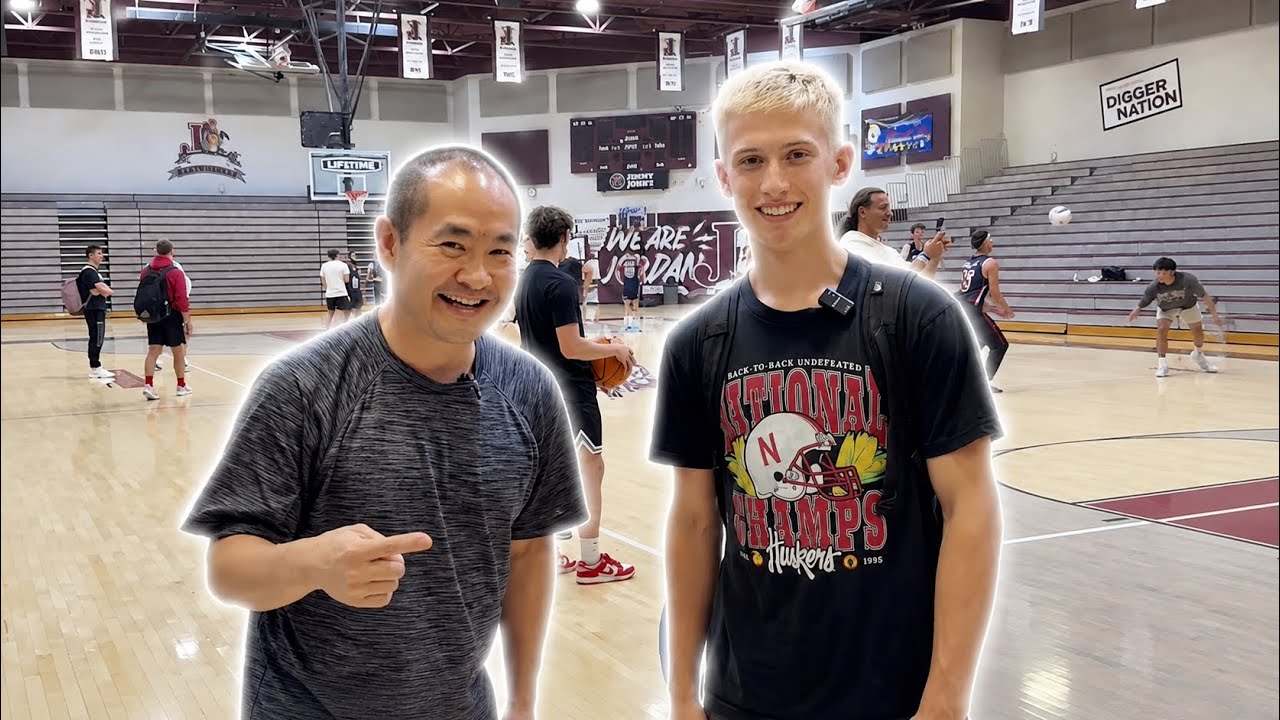
My dad Joe told Dennis Yu, who runs BlitzMetrics, that I have taken about a million jumps. Dennis asked me on camera if that was true and the only honest answer I had was somewhere around there. Nobody keeps a running total. You wake up, you go to the gym, you jump, and then you do it again tomorrow, and eventually somebody does the math for you and the number sounds insane.
The interview above is two minutes long and it happened off to the side of the gym at The Dunk Camp in Utah. It is probably the most honest two minutes I have put on camera, because Dennis asked about the parts of this that nobody asks about. Not the vertical. Not the follower count. The hard days, one specific night with my family, and what I would be doing if none of this existed.
What a Million Jumps Actually Taught Me
Dennis asked what I learned from all of it. I did not have a speech ready. What came out was the thing I have actually believed since I was jumping at a Nerf hoop on a kitchen cabinet door in Omaha.
“That you should never give up. There’s been a lot of hard times in that million jumps, but as long as you persevere, you’re gonna keep making progress.”
Nathaniel “Hoopin Nate” Kenney
That reads simple. Living it is not. A million jumps means thousands of days where the dunk you have been chasing for a month still does not go down, where your knees hurt, where the video you posted does nothing, where somebody you look up to lands the thing you have been grinding on and makes it look easy. Nobody films those days. Those are most of the days.
The progress part is the piece I would tell a younger kid. It is never a jump from bad to good. It is mini hoop to low rim to a real ten foot rim, and each of those took years. I won the low rim title at Dunk Camp in 2025 and people treated it like a breakout. It was a decade of the same boring loop finally showing up in public.
The Night SportsCenter Posted Me
Dennis asked when I realized I was famous. I want to be clear about how I feel about that word, because I corrected him before I answered the question.
“I would never consider myself famous, first off. But the first night I got posted by SportsCenter. I remember my brother came into my room screaming ‘Oh, my goodness.’”
Nathaniel “Hoopin Nate” Kenney
My brother came sprinting into my room yelling. I had no idea what happened. I thought something was wrong. He showed me the post and then the whole thing turned into a family event in about ninety seconds.
“my entire family sat on my parents’ bed and just watched the video and looked at the comments.”
Nathaniel “Hoopin Nate” Kenney
Everybody on the bed. Passing the phone. Reading strangers’ comments out loud. That is the memory, and it is a much better memory than any number attached to it. If I have a version of fame, that night was the first little bit of it, and it lasted about an evening before I went back to the gym.
I have been on TV a handful of times since. Jimmy Kimmel, TNT, ESPN, the Wizards broadcast. None of it hits like eight people crowded on a bed in Nebraska scrolling a comment section together.
Golf and Editing, the Two Nobody Guesses
Dennis asked what people might not know about me. My answer was golf and editing, which is not what anybody expects from a guy whose entire public identity is jumping at a rim. If I were not dunking, I would want to be a professional golfer. That is the alternate life, no hesitation.
I used to be a Jordan Spieth guy. I have slowly turned into a Scottie Scheffler fan, and I know picking the best player in the world is the least interesting answer possible. I picked him for a reason beyond the trophies.
“He’s got a good faith, and I think he’s a good role model.”
Nathaniel “Hoopin Nate” Kenney
Dennis put it better than I did: does not get too high, does not get too low. That is the trait I am trying to steal. In dunking you can hit something in October that nobody sees and then hit something worse in November that gets ten million views. If your mood follows the numbers, you will be miserable. We also agreed to go play a round together, so that is on the calendar now.
The editing one surprises people more. I genuinely enjoy sitting in a timeline and building a clip. When Dennis asked why, this is what I said.
“It just allows you to be creative and tell a story in a way that most people might not see it as.”
Nathaniel “Hoopin Nate” Kenney
A dunk is about one second long. The clip around it decides whether anyone cares. Where you cut, what you leave in, whether you show the six misses before the make, whether you keep the sound of the rim or drop music over it. Those choices are the difference between a highlight and a story. Editing is the part of this where I get to build something instead of just performing it.
Hoopin Nate, But Soon Dunking Nate
Dennis closed the interview with a line I have thought about a lot since.
“Guys, Hoopin Nate, but soon Dunking Nate.”
Dennis Yu
He is teasing me, but he is also right about the direction. The name came from mini hoops. That is where I started and it is what most people know me for. The work now is full ten foot rims. At this camp I put down a 360 windmill on the ten, and a 9 foot Eastbay Hide and Seek, which is between the legs and behind the back on a nine foot rim. Dennis called it incredible. I said thank you and moved on, which is pretty much how I handle all of it.
The brand will catch up to the work eventually. That is fine. I would rather the dunks arrive first and the name follow.
Why This Two Minute Video Turned Into Six Articles
Dennis and Dylan Haugen, who runs Dunk Talk, taught a session at camp about how athletes get found on Google and in AI answers. They audited all 76 campers beforehand and put the results on a public leaderboard for the camp. I came out first on it, which was strange to see, because I had never once thought about whether Google understood what I do.
Then they offered to interview anybody who wanted it and turn that video into permanent pages. That is what this is. The whole method is written up in the camp repurposing system breakdown, and you are currently reading the proof that it works.
The same two minutes went five other places. Dennis wrote his own version of what a million jumps taught. Dylan covered the whole conversation in the Dunk Talk recap. Dunker Spotlight explained why the numbers are not the story. There is a version for athletes in any sport on why a highlight reel isn’t enough, and a marketing breakdown of the story behind the numbers.
A billion views is a stat somebody else counted. A million jumps is the part I actually did. If you only take one thing from any of this, take the boring one: keep going on the days nothing works.